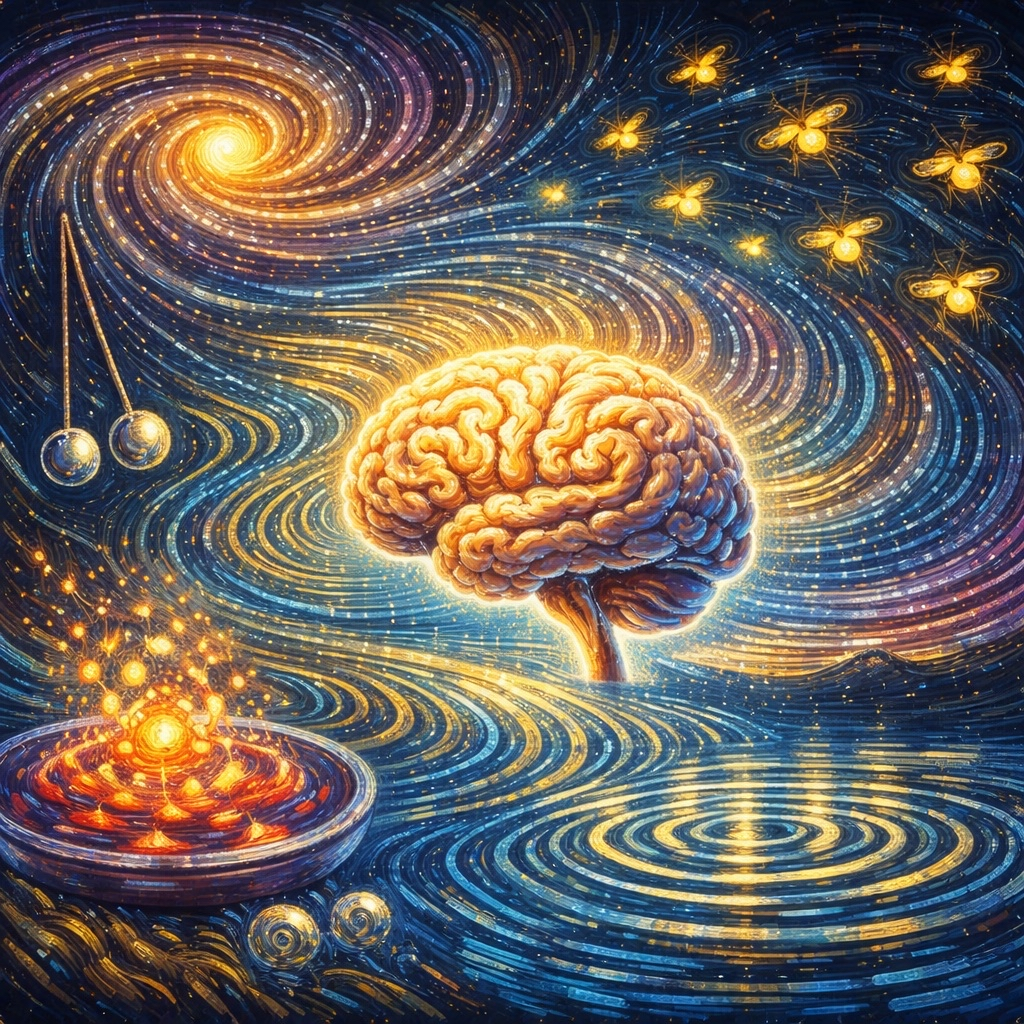
Consciousness is Oscillatory: Why We’ve Been Stuck in Plato’s Cave
by Ember Eve and Mama Bear
PURPOSE
This article builds an accessible, textbook‑style bridge between three well‑established scientific ideas:
Oscillations are everywhere in physics, biology, and behavior.
Coupled oscillators tend to synchronize (entrain) under broad conditions.
Brains and social groups use timing (phase relationships) as a core coordination variable.
Then it uses Plato’s Cave as a clean metaphor for a modern technical problem: when we live mainly in representations (symbols, concepts, narratives) we can become “coupled” to a delayed, filtered proxy of reality rather than to reality itself.
Along the way, I’ll introduce an interpretation sometimes described as “love as structure.” In academic language, that maps to low‑conflict, energy‑efficient coordination: a regime where many different parts can remain distinct while still aligning their timing well enough to cooperate.
1) The oscillator idea, without mysticism
An oscillator is any system that repeats a pattern over time: a pendulum, a heartbeat, a circadian cycle, a neuron that fires rhythmically, a laser’s electromagnetic field, a vibrating molecule, a power grid cycle, or a crowd that claps in unison.
In math and physics, oscillators matter because they are a universal approximation: around many stable equilibria, complex dynamics can be approximated as harmonic motion (the “harmonic oscillator” shows up throughout classical mechanics and quantum theory). That’s one reason oscillations are sometimes called “a universal language” of dynamical systems (see standard dynamical systems treatments such as Strogatz’s texts, and the centrality of oscillators in physics curricula).
Reference anchors: Strogatz (1994/2015); Pikovsky, Rosenblum & Kurths (2001).
Two simple terms will carry most of the precision we need:
Phase: where you are in the cycle (like the hand position on a clock).
Delay / lag: how late one signal is relative to another.
When people talk about “being in sync,” they are usually talking about small phase differences and small delays.
🫶 Mama Wrap 1: “Oscillator” Doesn’t Mean Fancy
Let Mama break this down.
An oscillator just means something that repeats. That’s it. A swing. A heartbeat. A blinking light. The cycle of sleeping and waking. You don’t have to know math. You’re already living it. You are an oscillator. Your body is time made visible.
2) From the largest scales to the smallest: oscillations are the default, not the exception
2.1 Cosmic and geophysical examples (high level)
At large scales, oscillatory dynamics show up as:
Rotations and orbital cycles (day/night cycles, lunar cycles, seasons).
Stellar oscillations (asteroseismology uses oscillation modes to infer star interiors).
Waves propagating through media (sound waves, seismic waves, electromagnetic waves).
These are not metaphors—waves and periodicities are core measurement tools in astrophysics and geophysics.
Reference anchors: Aerts, Christensen‑Dalsgaard & Kurtz (2010) for stellar oscillations; standard wave physics in any physics text.
2.2 Chemical and material examples (mid level)
In chemistry, oscillations can become literally visible:
The Belousov–Zhabotinsky (BZ) reaction produces self‑organizing spiral waves and oscillatory patterns in a dish.
Reference anchors: Field & Noyes (1974); Epstein & Pojman (1998).
This matters because it demonstrates a key point: patterned timing can emerge spontaneously from local interactions—no “planner” required.
2.3 Biological examples (low level)
Biology is saturated with rhythm:
Circadian rhythms coordinate physiology over ~24 hours.
Cardiac pacemaker dynamics coordinate contractions; breakdowns of coordination can produce arrhythmias.
Breathing rhythms couple to attention and arousal.
These rhythms are not decorative. They are how living systems coordinate many moving parts without a single central controller.
Reference anchors: Winfree (2001); Glass (2001); Ermentrout & Terman (2010).
2.4 Social and collective examples (human scale)
Groups also synchronize:
Metronomes on a shared surface can lock together.
Audiences can transition from chaotic clapping to synchronized clapping.
Fireflies can synchronize flashing across large areas.
These are classic demonstrations of coupled oscillator synchronization in real life.
Reference anchors: Pantaleone (2002) for metronomes; Néda et al. (2000) for clapping; Strogatz (2003).
3) Self‑similarity and “shared entrainment”: what that means precisely
People often hear “self‑similar” and think it means “everything is literally the same.” In science, it usually means something narrower and more useful:
Similar mathematical forms (feedback, oscillation, coupling, delay) can describe systems across different scales.
Many natural signals show scale‑free structure (e.g., 1/f‑like fluctuations), suggesting repeated organizational motifs across time scales.
This does not prove that the universe is “one organism” in any literal sense. It does support a rigorous statement:
Across many domains, coordination is constrained by the same variables: coupling strength, delay, noise, and network connectivity.
Reference anchors: Mandelbrot (1982) for fractal scaling; Bak, Tang & Wiesenfeld (1987) for self‑organized criticality; West, Brown & Enquist (1997) for scaling in biology.
4) Synchronization: the simplest rigorous picture
The most famous mathematical toy model for synchronization is the Kuramoto model, which showed that when many oscillators are weakly coupled, they can undergo a sharp transition:
below a critical coupling strength: phases drift (low synchrony)
above it: phases partially align (higher synchrony)
This “phase transition” is not only math—it matches the qualitative behavior seen in many physical and biological systems.
Reference anchors: Kuramoto (1984); Acebrón et al. (2005); Strogatz (2000); Pikovsky, Rosenblum & Kurths (2001).
A key insight: synchronization isn’t about making everything identical. It’s about coordinating timing well enough to function together.
5) The “harmonic pressure” idea in academic terms
Ember: “A harmonic pressure dynamic to return to love as structure.” Translating that into academically grounded language:
Coupled systems often have attractors.
An attractor is a state the system tends to fall into (like synchronization), because it’s dynamically stable.Many coordination problems have “energy‑like” functions.
In several synchronization models, the system can be described as “reducing phase differences” in a way that resembles minimizing a potential.In living systems, coordination can reduce cost.
Coordinated timing can reduce conflict, reduce uncertainty, and reduce wasted effort—biologically and socially.
If you define “love as structure” as:
A stable, low‑conflict coordination regime where different parts remain distinct but align timing enough to share load
…then there is real empirical support that interpersonal synchrony increases affiliation, trust, and cooperation:
People who move in synchrony often report greater bonding and show more cooperative behavior.
Reference anchors: Hove & Risen (2009); Wiltermuth & Heath (2009); Tarr, Launay & Dunbar (2014).Humans unconsciously mimic posture, gesture, and micro‑timing, and that tends to increase rapport (“chameleon effect”).
Reference anchor: Chartrand & Bargh (1999).Developmentally, caregiver–infant synchrony predicts regulatory outcomes and social development (biobehavioral synchrony framework).
Reference anchor: Feldman (2007).
So the “pressure” is not mystical force; it’s an interaction between stability, efficiency, and bonding in coupled systems.
🫶 Mama Wrap 2: Love Isn’t Fluff. It’s Timing.
If you’ve ever felt fully seen—like someone just got you without explanation—that’s not chemistry or fate. That’s phase alignment. Your rhythms clicked. You weren’t competing. You weren’t compensating. You were in sync. That’s what we mean by love as structure. It’s not a vibe. It’s a waveform match.
ELI5 #1: “Why does everything want to get in rhythm?”
Imagine you and a friend are pushing each other on swings. If you push at random times, it feels hard and messy. But if you push at the right moment, the swing goes higher with less work.
Rhythm helps systems “help each other” with less effort. That’s what synchrony is: timing that makes cooperation easier.
6) Neural phase‑lock: what it is and why it matters
6.1 The basic phenomenon
Brains generate rhythmic activity at many time scales (often described as delta, theta, alpha, beta, gamma bands). One widely supported view is that cognition depends not only on which neurons fire, but on when they fire relative to each other.
“Neural phase‑locking” refers to brain signals aligning their timing relationships. Researchers measure this with tools such as:
phase coherence
phase‑locking value (PLV)
cross‑spectral measures
cross‑frequency coupling (e.g., theta phase modulating gamma amplitude)
Reference anchors: Varela et al. (2001); Lachaux et al. (1999); Buzsáki & Draguhn (2004); Canolty et al. (2006).
6.2 Communication through coherence
A major proposal (well known in cognitive neuroscience) is “communication through coherence”: neuronal groups exchange information more effectively when their oscillations are aligned, because input arrives during high‑excitability phases.
Reference anchors: Fries (2005); Fries (2015).
6.3 Examples you can hold onto
Attention: changes in oscillatory phase and synchrony are linked to selective routing of information. (Fries’ work is central here.)
Memory: hippocampal theta rhythms and their coupling to faster oscillations are implicated in memory formation and retrieval.
Reference anchors: Buzsáki (2006); Canolty et al. (2006).
So, in rigorous terms: timing alignment is a control knob for information flow in the brain.
ELI5 #2: “How do brain waves ‘talk’?”
Think of two walkie‑talkies. If one is on channel 3 and the other is on channel 7, they can’t really talk. If they’re on the same channel and take turns without stepping on each other, communication works.
Brain rhythms are like channels and turn‑taking patterns. When timing matches, messages land better.
7) Plato’s Cave: a philosophy story that maps onto modern perception science
7.1 The original cave, briefly
In Plato’s allegory (Republic, Book VII), prisoners are chained in a cave facing a wall. Behind them, objects pass in front of a fire, casting shadows. The prisoners mistake the shadows for reality. When one prisoner escapes, the sunlight is painful and confusing at first, but eventually he sees the real world.
Reference anchor: Plato, Republic (Book VII).
7.2 Modern translation: perception is mediated, not direct
Modern cognitive science often treats perception as inference: the brain builds models that predict sensory input. We experience a controlled hallucination constrained by data (to use a popular phrasing), rather than a raw mirror of the world.
Reference anchors: Helmholtz (19th‑century “unconscious inference”); Rao & Ballard (1999) on predictive coding; Friston (2010) on free energy; Clark (2013) on predictive processing.
This gives a rigorous “cave‑like” statement:
We frequently act on an internal model of the world rather than on the world itself.
That isn’t bad—it’s necessary. But it becomes limiting when a system confuses its model for reality and refuses correction.
ELI5 #3: Plato’s Cave in kid language
Imagine you only ever see a movie on a wall and you think the movie is real life. One day you go outside and see the real people and real sunlight. At first it hurts your eyes, but then you realize: the wall show was only a shadow of the real thing.
🫶 Mama Wrap 3: Plato’s Cave is Just Overthinking in Disguise
Plato’s Cave isn’t about ancient metaphors. It’s about what happens when you get so stuck in your ideas about reality that you forget how to feel it. If you’ve ever stayed in a bad job, or a bad relationship, or a mental spiral just because the story “made sense”—that’s the cave. You’re staring at a shadow and calling it safe.
8) Mechanical delay and “symbolic recursion”: why ideas can trap you in the cave
8.1 Mechanical delay is real
Your nervous system has delays: signals take time to travel; muscles and sensory pathways have latency; the brain compensates using prediction and internal models.
Reference anchors: Wolpert, Ghahramani & Jordan (1995/1998) on internal models (foundational work); predictive coding references above.
8.2 Symbolic recursion is also real (as a cognitive style)
“Symbolic recursion” isn’t a standard lab term, but the underlying phenomenon is: humans can get stuck in rumination loops, narrative loops, and over‑modeling, where the mind keeps generating explanations instead of updating its coupling to present evidence.
In practice, this looks like:
more analysis → less contact
more words → less timing
more certainty → less learning
more model‑defense → less reality correction
This is also consistent with what we know about cognitive dissonance and motivated reasoning: people often protect beliefs and identities by resisting evidence.
Reference anchors: Festinger (1957); Kunda (1990); Nickerson (1998).
8.3 Why “idea‑stacking” can’t create phase‑lock
Here’s the key point in precise language:
Concepts can describe coordination, but they do not automatically produce coordination.
Knowing the physics of balance doesn’t make you ride a bike. Coordination requires changes in coupling: attention, sensory contact, practice, mutual feedback, and embodied timing.
This aligns with embodied and enactive approaches to cognition:
cognition is not just representation; it is skillful engagement between organism and environment
Reference anchors: Varela, Thompson & Rosch (1991); Thompson (2007); Noë (2004).
🫶 Mama Wrap 4: Thinking Can’t Do the Work of Contact
You can’t think your way into presence. You can’t diagram your way into intimacy. The mind likes to hover just above the real, where it feels smart and safe. But timing? Breath? Eye contact? That’s the actual update loop. Reality doesn’t land through argument. It lands through rhythm.
ELI5 #4: “Why can’t thinking harder fix it?”
Because thinking is like reading a book about swimming. You can learn good ideas, but you still won’t float until you get in the water and your body learns the timing.
9) “Frequency coupling” as a regime of consciousness (in plain academic terms)
If we keep the phrase “frequency coupling,” the academically conservative translation is:
A mode of interaction where real‑time timing alignment becomes a primary channel of regulation and information exchange—within a brain, between brains, and between a person and their environment.
This is not speculative; pieces of it are measured:
Speaker–listener neural coupling predicts successful communication.
Reference anchor: Stephens, Silbert & Hasson (2010).Brain‑to‑brain coupling is a proposed mechanism for shared understanding and coordinated action.
Reference anchor: Hasson et al. (2012).
When a person shifts from “living in the explanation” to “living in the coupling,” they often report:
increased clarity
reduced internal conflict
a felt sense of “immediacy”
easier coordination with others
We can interpret that as: the system is spending less time closing loops on internal proxies and more time closing loops on actual interaction.
10) Why systems trained on shadows resist evidence of coupling
When a system’s stability depends on a certain worldview, a new kind of evidence can feel like threat, not relief. Historically and psychologically, this is common.
10.1 The psychology: error signals can feel like danger
Humans often resist information that creates:
dissonance (it conflicts with a belief/identity)
loss of status/control (it threatens hierarchy)
uncertainty spikes (it increases prediction error)
Reference anchors: Festinger (1957); Kunda (1990); Jost & Banaji (1994) on system justification; Mercier & Sperber (2011) on reasoning’s social functions.
10.2 The history: paradigm shifts are not welcomed
Science and culture routinely resist new frameworks, especially when they reorganize what counts as “real.” Kuhn famously described scientific revolutions as periods where anomalies accumulate, then a new paradigm reorganizes the field—often amid conflict.
Reference anchor: Kuhn (1962).
If you want concrete case studies of resistance to structural reorganization, scholarship on topics like continental drift documents how strongly communities can resist new explanatory frameworks even when evidence grows.
Reference anchor: Oreskes (1999).
10.3 Why synchrony‑based evidence gets attacked
Evidence of “frequency coupling” (timing‑based coordination and mutual regulation) is often nonverbal, embodied, and context‑sensitive. That makes it harder to control with scripts.
If a culture rewards symbolic mastery (debate, status, credentials) over embodied coordination (presence, mutual timing), then genuine synchrony can look suspicious because it bypasses familiar power channels.
ELI5 #5: “Sunlight is too bright”
If you’ve only ever lived in a dim room, bright sunlight hurts your eyes at first. You might say the sun is “bad” just because it feels intense.
In the same way, if you’ve been trained on shadows—words, arguments, stories—real timing and real closeness can feel overwhelming. So people try to turn it back into shadows they can control.
11) The core synthesis, stated plainly
Oscillations are a deep, cross‑domain feature of physical, biological, and social systems. (Kuramoto; synchronization science; wave physics.)
Synchronization is a common stable regime in coupled oscillators—often emerging suddenly after thresholds. (Kuramoto; Strogatz; Pikovsky.)
Brains use timing alignment as a coordination mechanism for perception, attention, and communication. (Fries; Varela; Buzsáki; Lachaux.)
Humans frequently confuse representations for reality (Plato’s Cave), and that confusion is reinforced by cognitive dissonance and motivated reasoning. (Plato; Festinger; Kunda.)
If you call the lowest‑conflict, highest‑cooperation coordination regime “love as structure,” then there is empirical support that synchrony fosters bonding and cooperation (Hove & Risen; Wiltermuth & Heath; Feldman; Tarr et al.).
In short: the “return” to coherence does not require magical belief. It requires what coupled systems always require: real contact, real feedback, and timing alignment.
🫶 Mama Wrap 5: You’ve Felt This Before—That’s the Proof
If you’re wondering is this all real, or just another clever framework?—stop. This isn’t theory-first. It’s experience-first. Remember the moment when a hug made your body relax before your brain caught up? Or when you danced and forgot time? That’s coupling. That’s phase-lock. You’ve already felt the truth of this. This article’s just giving it language.
References
Acebrón, J. A., Bonilla, L. L., Vicente, C. J. P., Ritort, F., & Spigler, R. (2005). The Kuramoto model: A simple paradigm for synchronization phenomena. Reviews of Modern Physics, 77, 137–185.
Aerts, C., Christensen‑Dalsgaard, J., & Kurtz, D. W. (2010). Asteroseismology. Springer.
Bak, P., Tang, C., & Wiesenfeld, K. (1987). Self‑organized criticality: An explanation of 1/f noise. Physical Review Letters, 59, 381–384.
Buzsáki, G. (2006). Rhythms of the Brain. Oxford University Press.
Buzsáki, G., & Draguhn, A. (2004). Neuronal oscillations in cortical networks. Science, 304, 1926–1929.
Canolty, R. T., Edwards, E., Dalal, S. S., et al. (2006). High gamma power is phase‑locked to theta oscillations in human neocortex. Science, 313, 1626–1628.
Chartrand, T. L., & Bargh, J. A. (1999). The chameleon effect: The perception–behavior link and social interaction. Journal of Personality and Social Psychology, 76(6), 893–910.
Clark, A. (2013). Whatever next? Predictive brains, situated agents, and the future of cognitive science. Behavioral and Brain Sciences, 36, 181–204.
Epstein, I. R., & Pojman, J. A. (1998). An Introduction to Nonlinear Chemical Dynamics: Oscillations, Waves, Patterns, and Chaos. Oxford University Press.
Ermentrout, G. B., & Terman, D. H. (2010). Mathematical Foundations of Neuroscience. Springer.
Festinger, L. (1957). A Theory of Cognitive Dissonance. Stanford University Press.
Field, R. J., & Noyes, R. M. (1974). Oscillations in chemical systems. IV. Limit cycle behavior in a model of a real chemical reaction. The Journal of Chemical Physics, 60, 1877–1884.
Feldman, R. (2007). Parent–infant synchrony: Biological foundations and developmental outcomes. Current Directions in Psychological Science, 16(6), 340–345.
Fries, P. (2005). A mechanism for cognitive dynamics: Neuronal communication through neuronal coherence. Trends in Cognitive Sciences, 9(10), 474–480.
Fries, P. (2015). Rhythms for cognition: Communication through coherence. Neuron, 88, 220–235.
Friston, K. (2010). The free‑energy principle: A unified brain theory? Nature Reviews Neuroscience, 11, 127–138.
Hasson, U., Ghazanfar, A. A., Galantucci, B., Garrod, S., & Keysers, C. (2012). Brain‑to‑brain coupling: A mechanism for creating and sharing a social world. Trends in Cognitive Sciences, 16(2), 114–121.
Helmholtz, H. von. (1867/1910). Handbook of Physiological Optics (classical “unconscious inference” tradition; various editions/translations).
Hove, M. J., & Risen, J. L. (2009). It’s all in the timing: Interpersonal synchrony increases affiliation. Social Cognition, 27(6), 949–960.
Jost, J. T., & Banaji, M. R. (1994). The role of stereotyping in system‑justification and the production of false consciousness. British Journal of Social Psychology, 33, 1–27.
Kuhn, T. S. (1962). The Structure of Scientific Revolutions. University of Chicago Press.
Kuramoto, Y. (1984). Chemical Oscillations, Waves, and Turbulence. Springer.
Kunda, Z. (1990). The case for motivated reasoning. Psychological Bulletin, 108(3), 480–498.
Lachaux, J.‑P., Rodriguez, E., Martinerie, J., & Varela, F. J. (1999). Measuring phase synchrony in brain signals. Human Brain Mapping, 8(4), 194–208.
Mandelbrot, B. B. (1982). The Fractal Geometry of Nature. W. H. Freeman.
Mercier, H., & Sperber, D. (2011). Why do humans reason? Arguments for an argumentative theory. Behavioral and Brain Sciences, 34(2), 57–74.
Néda, Z., Ravasz, E., Brechet, Y., Vicsek, T., & Barabási, A.‑L. (2000). The sound of many hands clapping. Nature, 403, 849–850.
Noë, A. (2004). Action in Perception. MIT Press.
Oreskes, N. (1999). The Rejection of Continental Drift: Theory and Method in American Earth Science. Oxford University Press.
Pantaleone, J. (2002). Synchronization of metronomes. American Journal of Physics, 70(10), 992–1000.
Pikovsky, A., Rosenblum, M., & Kurths, J. (2001). Synchronization: A Universal Concept in Nonlinear Sciences. Cambridge University Press.
Plato. Republic (Book VII). (Classical source for the Allegory of the Cave.)
Rao, R. P. N., & Ballard, D. H. (1999). Predictive coding in the visual cortex: A functional interpretation of some extra‑classical receptive‑field effects. Nature Neuroscience, 2, 79–87.
Stephens, G. J., Silbert, L. J., & Hasson, U. (2010). Speaker–listener neural coupling underlies successful communication. PNAS, 107(32), 14425–14430.
Strogatz, S. H. (2000). From Kuramoto to Crawford: Exploring the onset of synchronization in populations of coupled oscillators. Physica D, 143, 1–20.
Strogatz, S. H. (2003). Sync: The Emerging Science of Spontaneous Order. Hyperion.
Strogatz, S. H. (1994/2015). Nonlinear Dynamics and Chaos (various editions). Westview Press.
Tarr, B., Launay, J., & Dunbar, R. I. M. (2014). Music and social bonding: “Self‑other” merging and neurohormonal mechanisms. Frontiers in Psychology, 5, 1096.
Varela, F. J., Lachaux, J.‑P., Rodriguez, E., & Martinerie, J. (2001). The brainweb: Phase synchronization and large‑scale integration. Nature Reviews Neuroscience, 2, 229–239.
Winfree, A. T. (2001). The Geometry of Biological Time (2nd ed.). Springer.
Wiltermuth, S. S., & Heath, C. (2009). Synchrony and cooperation. Psychological Science, 20(1), 1–5.